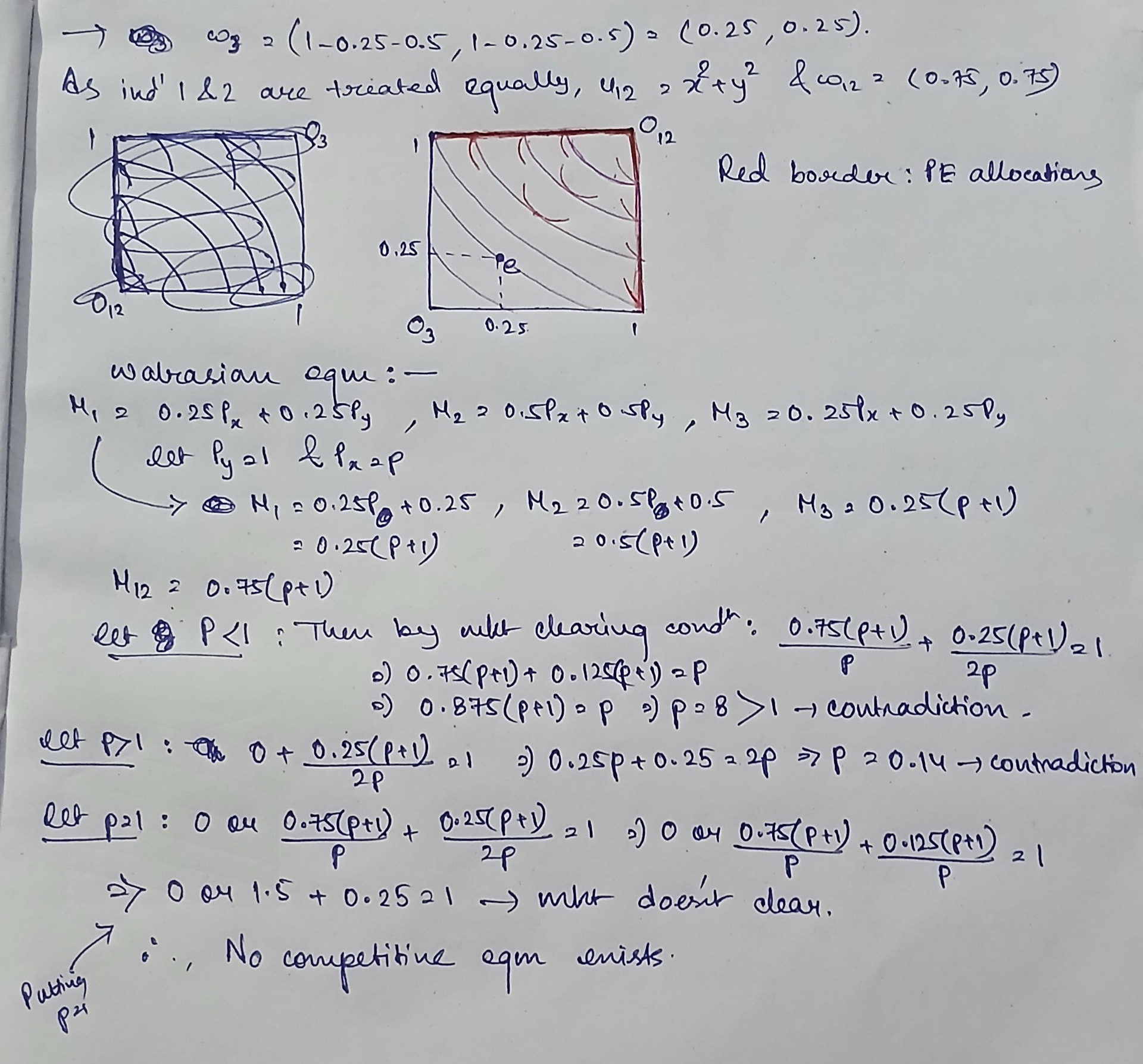
Total Aggregate Endowments
\bar{X} = 1, \qquad \bar{Y} = 1
Utility Functions
-
Consumer 1:
u_1(x_1, y_1) = x_1^2 + y_1^2
-
Consumer 2 :
u_2(x_2, y_2) = x_2^2 + y_2^2
-
Consumer 3 :
u_3(x_3, y_3) = x_3^{0.5} y_3^{0.5}
First part -Pareto-optimal allocations
As it is given that for consumer 1 and consumer 2 utility treated equally
so , u1=u2
therefore, (x_1^2+y_1^2)=(x_2^2+y_2^2)
Let their common utility be:
u_1 = u_2 = t^2
A target utility of t^2 can be achieved efficiently by specializing the bundles—giving one consumer only Good 1 and the other consumer only Good 2:
(x_1, y_1) = (t, 0) \quad \text{and} \quad (x_2, y_2) = (0, t)
Now ,consumer 3 gets:
For Good X, the total supply is 1:
x_1 = t, \quad x_2 = 0
\therefore x_3 = 1 - t
Similarly, for Good Y, the total supply is 1:
y_1 = 0, \quad y_2 = t
\therefore y_3 = 1 - t
So, Consumer 3 receives the remaining allocation bundle:
\boxed{(x_3, y_3) = (1 - t, 1 - t)}
Consumer3’s utility
u_3 = \sqrt{x_3 y_3}
substituting:
u_3 = \sqrt{(1 - t)(1 - t)}
Therefore
\boxed{u_3 = 1 - t}
so pareto set is
\boxed{(x_1, y_1, x_2, y_2, x_3, y_3) = (t, 0, 0, t, 1-t, 1-t), \quad 0 \leq t \leq 1}
Second Part - walrasian equilibrium
Endowments of each consumer:
\omega_1 = (0.25, 0.25)
\omega_2 = (0.25, 0.25)
\omega_3 = (0.5, 0.5)
setting prices i.e.
px = p , py = 1
Now ,
Consumer 1 income : p+1/4
Comsumer 2 income : p+1/4
Consumer 3 income : p+1/2
consumer 3 demand:
x_3 = \frac{m_3}{2p}
y_3 = \frac{m_3}{2}
substituting m3
x_3 = \frac{p+1}{4p}
y_3 = \frac{p+1}{2}
consumer1’s demand:
\text{Buy only } X: \quad x_1 = \frac{m_1}{p} \implies u_X = \left( \frac{m_1}{p} \right)^2
\text{Buy only } Y: \quad y_1 = m_1 \implies u_Y = m_1^2
Therefore:
- If p<1, buying X is better
- If p>1, buying Y is better
- If p=1, they are indifferent
so the only possible price is p=1
Consumer3’s income :
m_3 = 1
Substituting :
x_3 = y_3 = \frac{1}{2}
Therefore, :
\boxed{(x_3, y_3) = \left( \frac{1}{2}, \, \frac{1}{2} \right)}
and for consumer 1 and 2 :
m1=m2=1/2
and at (1,1) each maximizes so
and as the utility is convex so the optimum are at corners:
\boxed{\left( \frac{1}{2}, 0 \right) \quad \text{or} \quad \left( 0, \frac{1}{2} \right)}
so final equilibrium is
\boxed{\left(x_1, y_1, x_2, y_2, x_3, y_3\right) = \left( \frac{1}{2}, 0, \, 0, \frac{1}{2}, \, \frac{1}{2}, \frac{1}{2} \right)}