Consider the utility function u(x, y) = \sqrt{x^2+y^2}.
For a target utility \mu \geq 0, find the Hicksian demand correspondence (X^h,Y^h)(p_x, p_y, \mu), and the expenditure function e(p_x, p_y, \mu).
The Hicksian problem is:
\min_{x,y \in \mathbb{R}^2_+}\; p_xx + p_yy
\quad \text{s.t.} \quad
\sqrt{x^2 + y^2} \ge \mu
The slope of the budget line is \frac{P_x}{P_y}
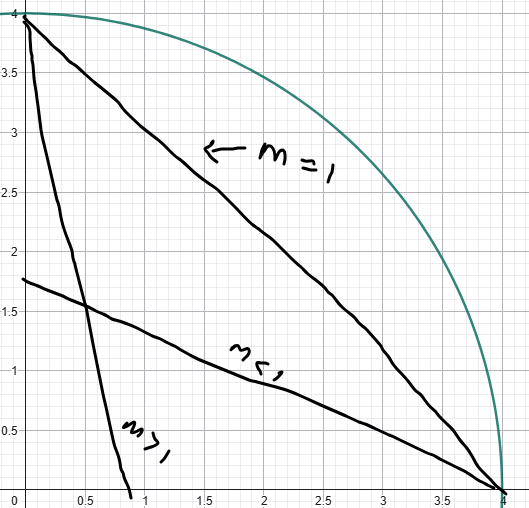
Expenditure is minimized by buying only the cheaper good. Therefore,
(X^h, Y^h)(p_x, p_y, \mu) =
\begin{cases}
(\mu, 0), & \frac{P_x}{P_y} < 1 \\
(0, \mu), & \frac{P_x}{P_y} > 1 \\
\{(\mu, 0), (0, \mu)\}, & \frac{P_x}{P_y} = 1
\end{cases}
And the expenditure function is
e(p_x, p_y, \mu) = \mu min\{p_x, p_y\}
\min_{x, y} \quad p_x x + p_y y \quad
subject to:
\sqrt{x^2 + y^2} \geq \mu
now :
\sqrt{x^2 + y^2} = \mu
{x^2 + y^2} = \mu^2
As this is an equation of circle
We are taking MRS
MU_x = \frac{x}{\sqrt{x^2 + y^2}}, \quad MU_y = \frac{y}{\sqrt{x^2 + y^2}}
Hence,
MRS = \frac{MU_y}{MU_x} = \frac{y}{x}
At an interior optimum,
\frac{y}{x} = \frac{p_y}{p_x}
So,
x = \left(\frac{p_y}{p_x}\right) y
Substituting into the utility constraint equation:
x^2 + y^2 = \mu^2
Therefore
\left( \frac{p_y}{p_x} y \right)^2 + y^2 = \mu^2
y^2 \left( \frac{p_y^2}{p_x^2} + 1 \right) = \mu^2
y^2 = \frac{\mu^2 p_y^2}{p_x^2 + p_y^2}
Therefore,
\boxed{y = \frac{\mu p_y}{\sqrt{p_x^2 + p_y^2}}}
Similarly,
\boxed{x = \frac{\mu p_x}{\sqrt{p_x^2 + p_y^2}}}
Checking Corner Points
Corner 1
(x, y) = (\mu, 0) \implies U = \sqrt{\mu^2} = \mu
E = \mu p_x
Corner 2
(x, y) = (0,\mu) \implies U = \sqrt{\mu^2} = \mu
E = \mu p_y
So by this
Hicksian Demand Function :-
\boxed{
(X^h, Y^h)(p_x, p_y, \mu) = \left\{
\begin{array}{ll}
\{(\mu, 0)\} & ,\text{if } p_x < p_y \\
\{(0, \mu)\} & ,\text{if } p_x > p_y \\
\{(\mu, 0), (0, \mu)\} & ,\text{if } p_x = p_y
\end{array}
\right.
}
Expenditure Function
Since
\sqrt{p_x^2 + p_y^2} > \min\{p_x, p_y\}
the interior solution is always more expensive than buying only the cheaper good.
Therefore ,
\boxed{e(p_x, p_y, \mu) = \mu \min\{p_x, p_y\}}