Suppose we have two consumers, 1 and 2, with identical utility functions u_i(x_i, y_i) = \max\{x_i, y_i\}. The economy has 1 unit of good X and 2 units of good Y.
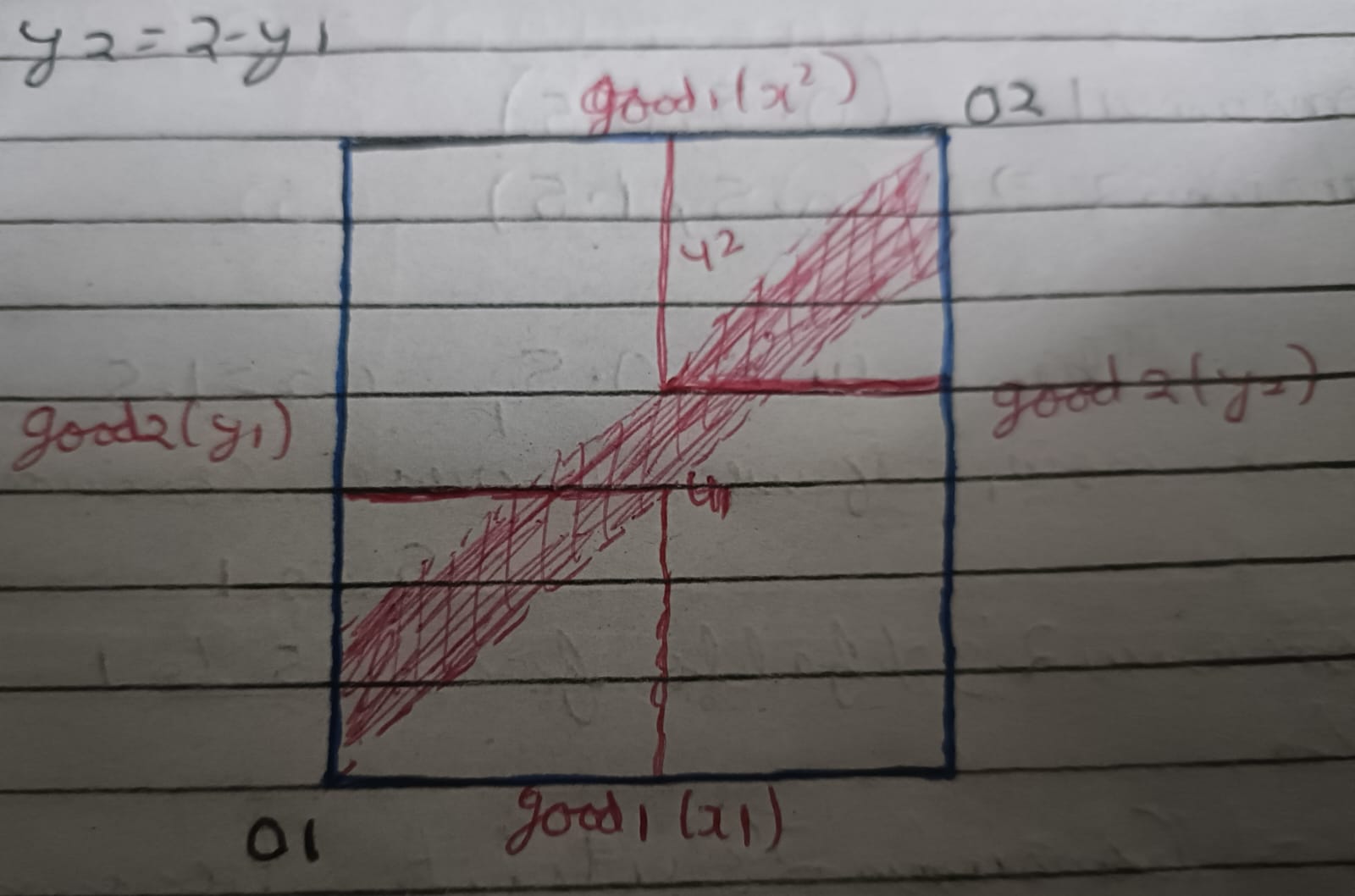
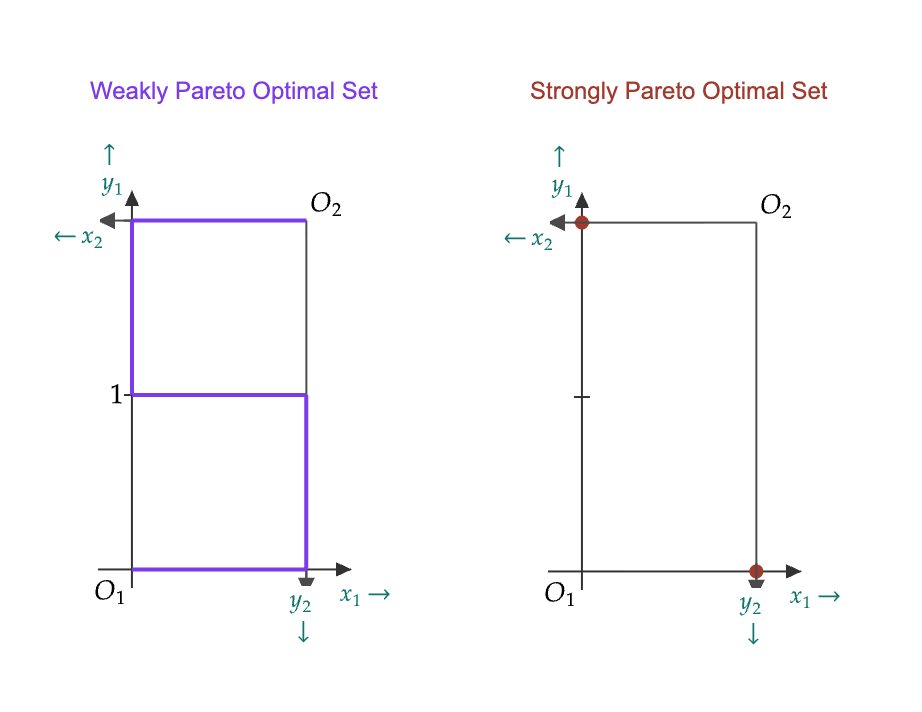
Draw an Edgeworth box and illustrate the (strongly) Pareto efficient set and the weakly Pareto efficient set.
Definitions of Pareto efficiency:
- A feasible allocation a is a weakly Pareto efficient allocation if there is no feasible allocation a' such that all agents strictly prefer a' to a.
- A feasible allocation a is a strongly Pareto efficient allocation if there is no feasible allocation a' such that all agents weakly prefer a' to a, and some agent strictly prefers a' to a.
Total Endowments: \bar{X} = 1 (Good 1), \bar{Y} = 2 (Good 2).
Feasibility Constraints: (x_1, y_1): x_2 = 1 - x_1
where 0 \leq x_1 \leq 1 and y_2 = 2 - y_1 where 0 \leq y_1 \leq 2.
Utility Functions: u_i(x_i, y_i) = \max\{x_i, y_i\} for i \in \{1, 2\}.
The Strongly Pareto Efficient Set
An allocation is strongly Pareto efficient if it is impossible to make one consumer strictly better off without making the other consumer strictly worse off.
Total Endowments: \bar{X} = 1 (Good 1), \bar{Y} = 2 (Good 2). Feasibility Constraints: For any allocation (x_1, y_1): x_2 = 1 - x_1 where 0 \leq x_1 \leq 1 and y_2 = 2 - y_1 where 0 \leq y_1 \leq 2. Utility Functions: u_i(x_i, y_i) = \max\{x_i, y_i\} for i \in \{1, 2\}.
The strongly Pareto efficient set forms a diagonal band cutting through the Edgeworth Box
The Weakly Pareto Efficient Set
An allocation is weakly Pareto efficient if it is impossible to make both consumers strictly better off at the same time.
The weak set consists of the entire strong diagonal band PLUS all four outer boundaries (edges) of the Edgeworth Box.
Now, let’s look at the Edgeworth box, where (y_1 = 2)
- What is happening here? There are only 2 units of Good 2 in the whole economy, and Consumer 1 is holding all 2 units ((y_1 = 2))
- Look at Consumer 1’s happiness: Their utility is u_1 = \max\{x_1, 2\} = 2
Because 2 is the maximum amount of Good 2 that exists, Consumer 1’s utility cannot physically go any higher. They are maxed out.
- Conclusion: Since Consumer 1 cannot be made any happier, it is impossible to make both consumers strictly happier at the same time. This means the top border is Weakly Pareto Efficient
Let F denote the set of all feasible allocations.
Set of weakly Pareto efficient allocations = \{((x_1,y_1),(x_2,y_2))\in F|\max\{x_1,y_1\}\geq 1 \text{ and } \max\{x_2,y_2\}\geq 1\}\cup\{((x_1,y_1),(x_2,y_2))\in F|\max\{x_1,y_1\}=2 \text{ or }\max\{x_2,y_2\}=2\}
Set of strongly Pareto efficient allocations = \{((1,0),(0,2)),((0,2),(1,0))\}