u(x,y) = x^{\alpha} y^{1-\alpha}, \quad \text{where } 0 < \alpha < 1
The budget constraint is given by:
p_x x + p_y y \leq M
Substituting the parameters M = 1000, p_x = 10, and p_y = 5:
10x + 5y \leq 1000
\boxed{2x + y \leq 200}
Coupon Constraint
5x + 10y \leq 1000
\boxed{x + 2y \leq 200}
Optimization Problem:
\max_{x, y} \quad x^{\alpha} y^{1-\alpha} \quad \text{s.t.} \quad 2x + y \leq 200, \quad x + 2y \leq 200, \quad x, y \geq 0
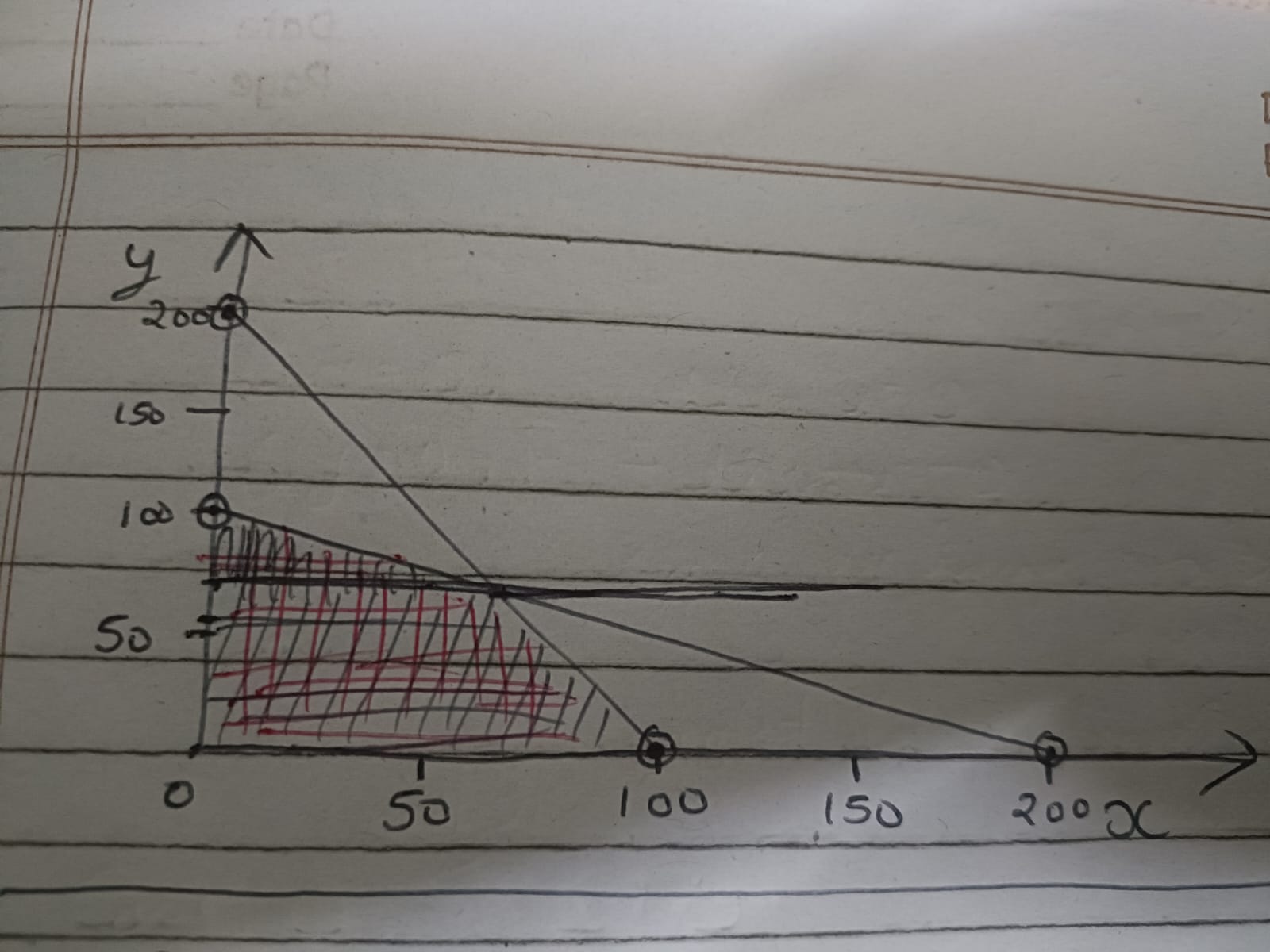
2x + y = 200 \implies \text{Intercepts: } (100,0), \, (0,200) \quad \text{Slope: } -2
x + 2y = 200 \implies \text{Intercepts: } (200,0), \, (0,100) \quad \text{Slope: } -\frac{1}{2}
\begin{cases} 2x + y = 200 \\ 2x + 4y = 400 \end{cases} \implies 3y = 200 \implies y = \frac{200}{3}
2x + \frac{200}{3} = 200 \implies 2x = \frac{400}{3} \implies x = \frac{200}{3}
\therefore \boxed{\left(x, y\right) = \left( \frac{200}{3}, \frac{200}{3} \right)}
Now B part
u(x,y) = x^{\alpha}y^{1-\alpha}
x = 0 \implies u = 0, \quad y = 0 \implies u = 0
\exists \, (x,y) \in \text{Feasible Set} \text{ s.t. } x > 0, y > 0 \implies u(x,y) > 0
\therefore \boxed{x^* \neq 0 \quad \text{and} \quad y^* \neq 0}
so they can’t be optimal
c part
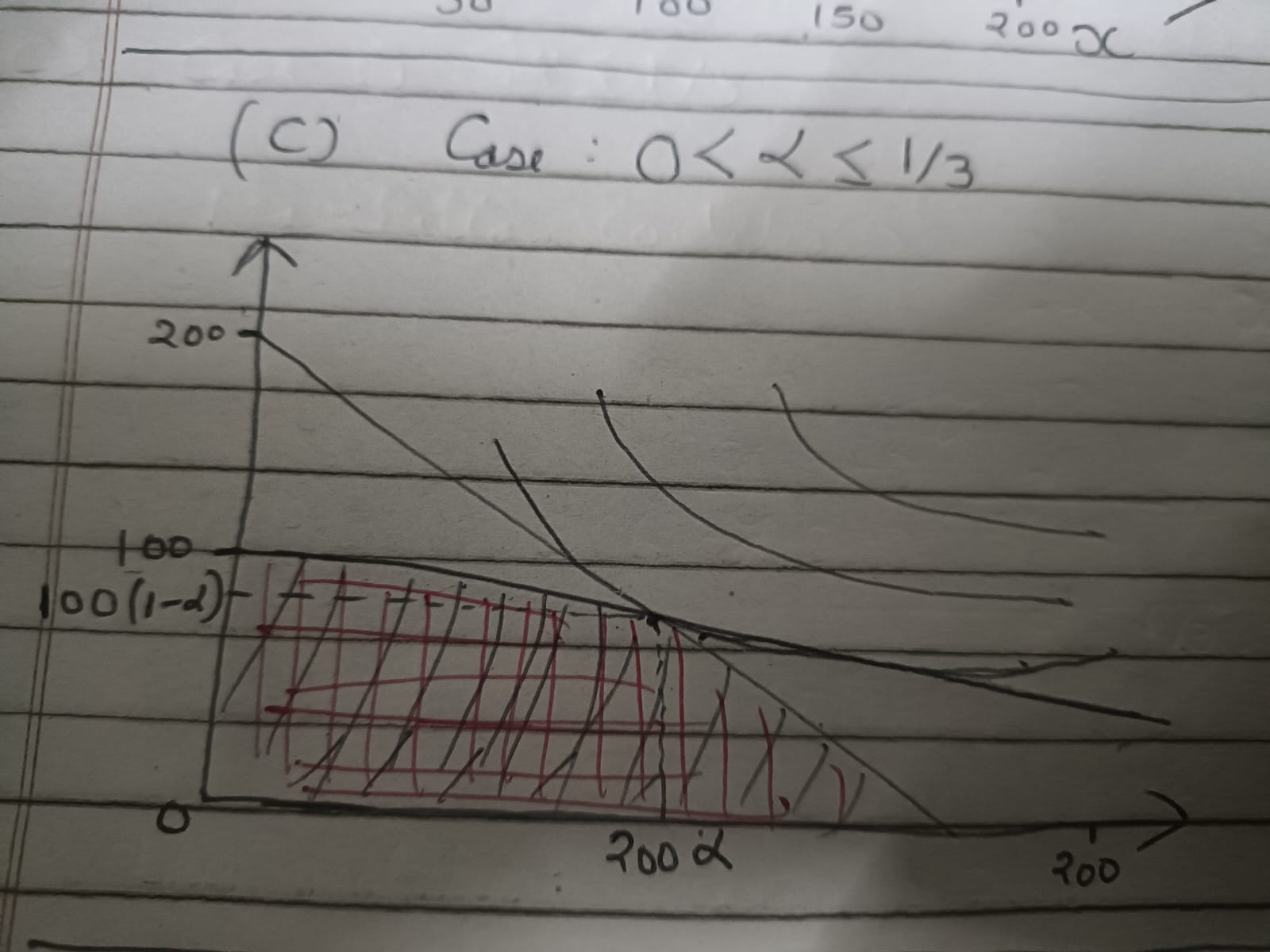
For small values of α\alphaα, the consumer places relatively more importance on bread (y) than sugar (x). Since bread requires more coupons per unit than sugar, it is natural to expect the coupon constraint to bind
x + 2y = 100
Solves using Lagrangian
\mathcal{L} = x^{\alpha} y^{1-\alpha} + \lambda (200 - x - 2y)
first-order conditions :
(x, y) = (200\alpha, \, 100(1-\alpha))
To verify :
2x + y \leq 200
Substituting our candidate values:
2(200\alpha) + 100(1-\alpha) \leq 200
400\alpha + 100 - 100\alpha \leq 200
300\alpha \leq 100 \implies \alpha \leq \frac{1}{3}
Hence, for the parameter range 0 < \alpha \leq \frac{1}{3}, the money constraint is not violated, and the global optimal bundle is:
\boxed{(x^*, y^*) = (200\alpha, \, 100(1-\alpha))}
Now part d
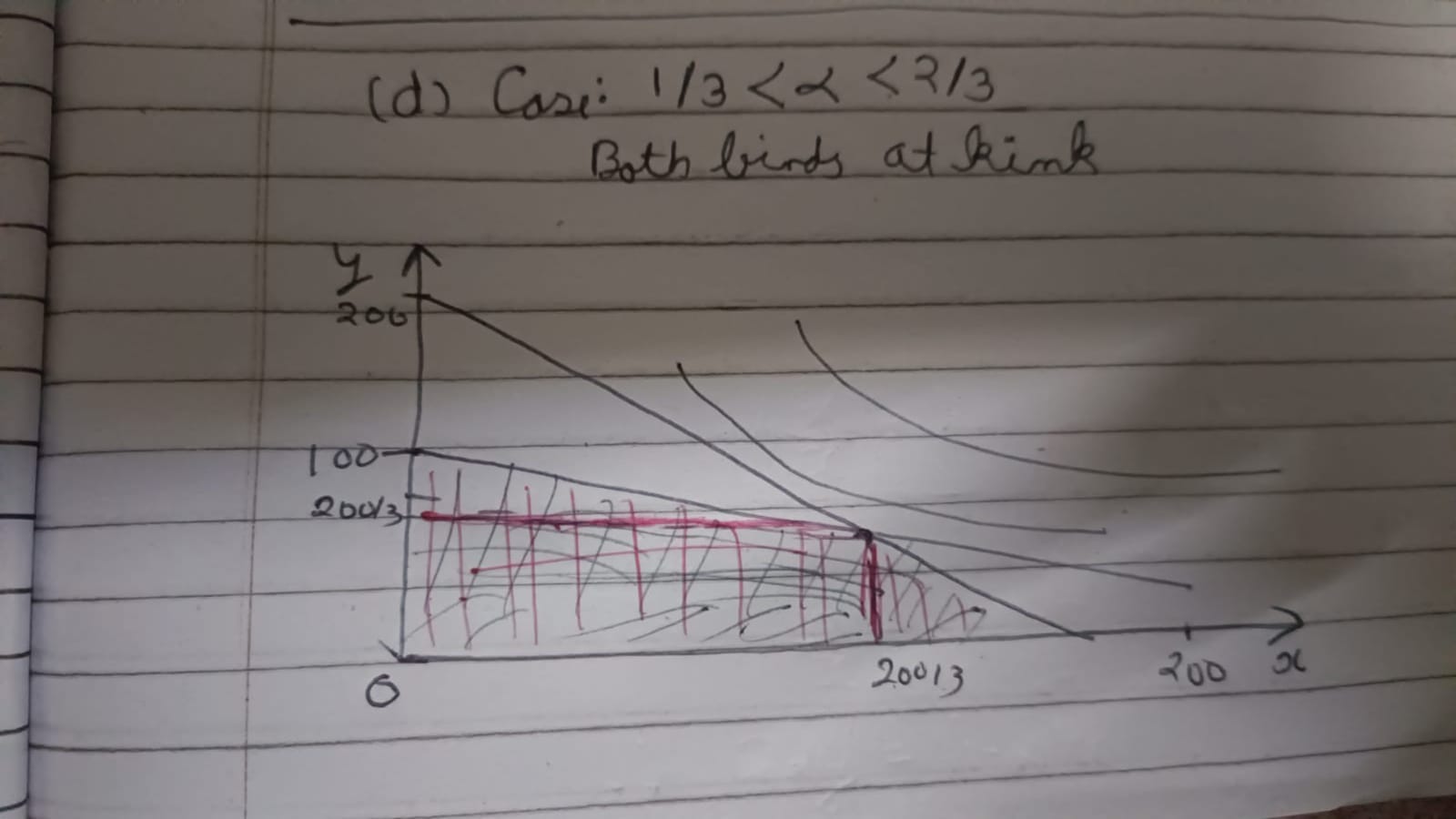
Here, neither constraint alone can determine the optimum. Hence, both constraints must bind simultaneously at a corner vertex of the budget set:
2x + y &= 200
x + 2y &= 200
Solving this linear system of equations gives:
x = y = \frac{200}{3}
Thus, for this specific parameter range, the optimal bundle is stuck at the kink:
\boxed{(x^*, y^*) = \left( \frac{200}{3}, \frac{200}{3} \right)}
Now part e
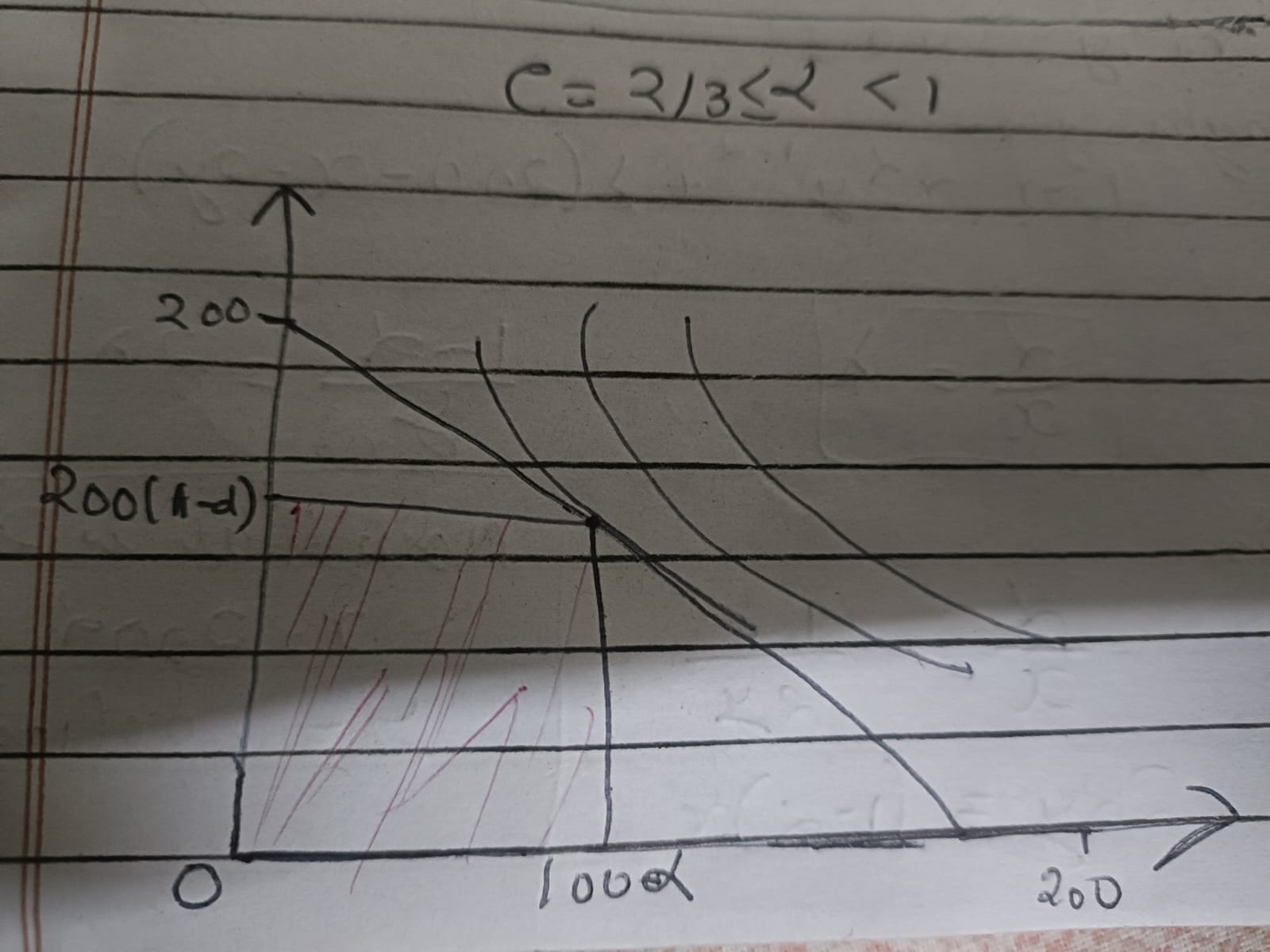
For larger values of \alpha, the consumer places relatively more importance on sugar (x). Since sugar is more expensive in terms of money (p_x = 10 > p_y = 5), we expect the money constraint to bind.
money constraint :
2x + y = 200
using the Lagrangian:
\mathcal{L} = x^{\alpha} y^{1-\alpha} + \lambda (200 - 2x - y)
first-orders :
(x, y) = (100\alpha, \, 200(1-\alpha))
Substituting :
x + 2y \leq 200
(100\alpha) + 2(200(1-\alpha)) \leq 200
100\alpha + 400 - 400\alpha \leq 200
200 \leq 300\alpha \implies \alpha \geq \frac{2}{3}
Hence, for the range \frac{2}{3} \leq \alpha < 1, the candidate bundle is feasible and constitutes the optimal bundle:
\boxed{(x^*, y^*) = (100\alpha, \, 200(1-\alpha))}