Problem Statement
We want to maximize u(x,y) = \ln(x + 2) + 2 \ln(y + 3) subject to p_x x + p_y y \le M and x,y \ge 0.
The utility function is strictly increasing in both x and y, and the budget constraint is: p_x x + p_y y = M.
Also, the utility function is strictly quasi-concave and differentiable for all x, y \ge 0. This ensures that if an interior stationary point exists where the tangency condition holds, it represents a global maximum.
First-Order Conditions (Interior Solution)
Now, we find the marginal utilities:
MU_x = \frac{1}{x + 2}
MU_y = \frac{2}{y + 3}
At interior optimum, the Marginal Rate of Substitution equals the price ratio:
MRS = \frac{MU_x}{MU_y} = \frac{p_x}{p_y}
\frac{y + 3}{2(x + 2)} = \frac{p_x}{p_y}
Now, we cross-multiply and isolate p_y y:
p_y (y + 3) = 2p_x (x + 2)
p_y y + 3p_y = 2p_x x + 4p_x
p_y y = 2p_x x + 4p_x - 3p_y
Now, we substitute above expression for p_y y into the binding budget constraint:
p_x x + (2p_x x + 4p_x - 3p_y) = M
3p_x x + 4p_x - 3p_y = M
3p_x x = M - 4p_x + 3p_y
Finally, we isolate x and get the Marshallian demand for x:
x^* = \frac{M - 4p_x + 3p_y}{3p_x}
Substituting x^* back into the budget constraint to get y we get:
p_y y = M - p_x \left( \frac{M - 4p_x + 3p_y}{3p_x} \right)
p_y y = \frac{3M - (M - 4p_x + 3p_y)}{3}
p_y y = \frac{2M + 4p_x - 3p_y}{3}
y^* = \frac{2M + 4p_x - 3p_y}{3p_y}
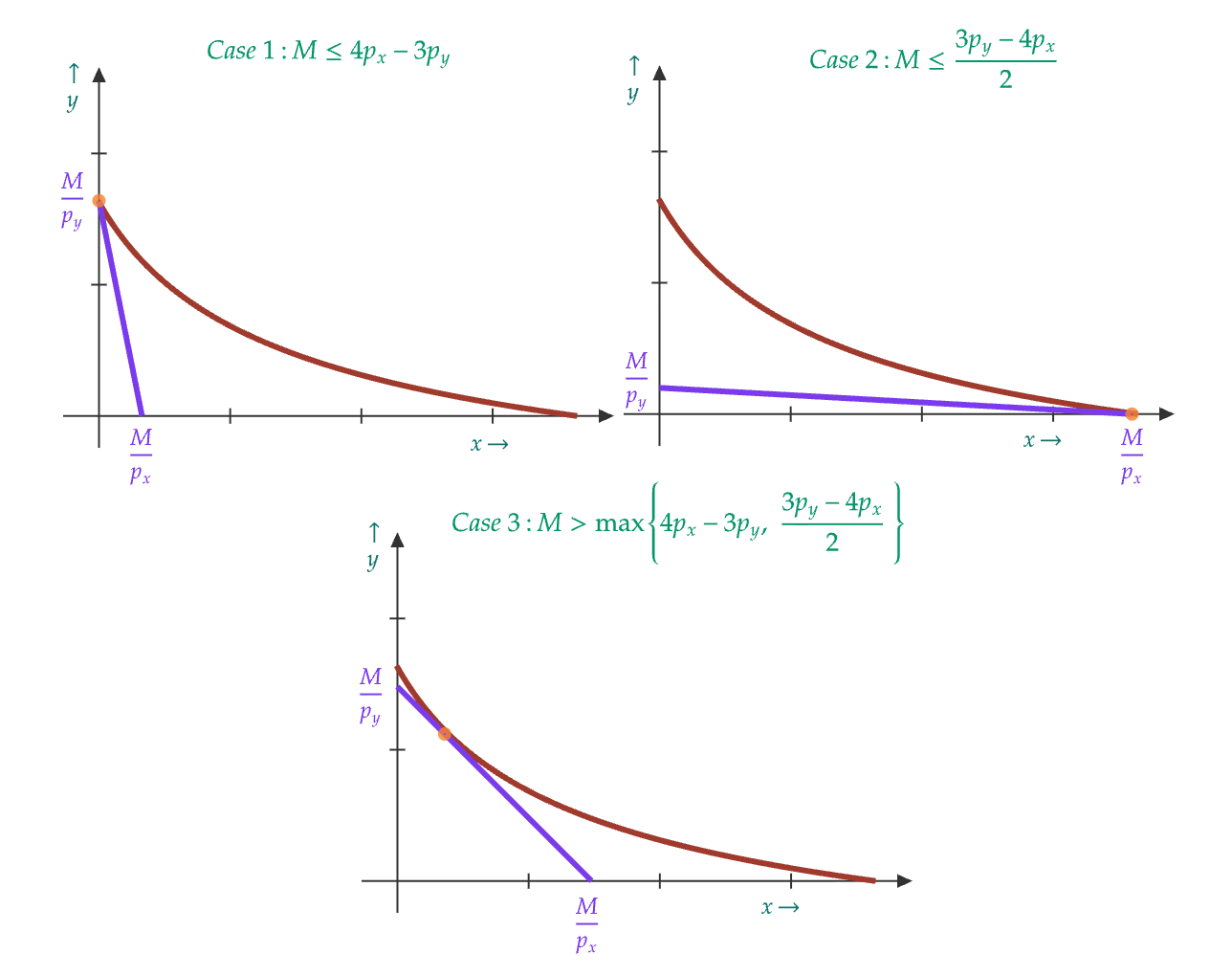
The interior solution (x^*, y^*) is only valid if the non-negativity constraints hold.
For x \ge 0, we need M \ge 4p_x - 3p_y.
For y \ge 0, we need M \ge \frac{3p_y - 4p_x}{2}.
(Note for Amit Sir – Please explain in class how to proceed graphically if M does not satisfy the above condition)